  "A
Comparison of Hull Designs" "A
Comparison of Hull Designs"
- Wisconsin Versus Florida -
by
Dr. John
A. Gilbert
Co-Faculty Advisor, Team UAH
Another ConcreteCanoe.org
exclusive!
As mentioned in "The
Front Line" ... I think that the Florida Gators will give the Wisconsin
Badgers a run for their money on the pond. So...
The
question is: "How well will "Gladigator" stack
up to "Descendant"?
Disclaimer
Please remember that the opinions expressed here are my own
and do not reflect those of Team UAH, ASCE, ACI, ConcreteCanoe.org, and/or the
sponsors of the 2007 NCCC. I'm grabbing at straws in rendering the two
teams' designs... but I think that most of what I say will be right on the
mark. If you come to Seattle... you can make your own assessment and
I'll see for myself.
Analysis
The figure below
shows what I think that the two boats will look like. I've included cross
sections at the widest points. The dimensions may be slightly off and the
wall construction may not be accurate... but I think that the shapes will be
dead on.

"Descendant"
Last year
Wisconsin's
hull design team
improved maneuverability, increased stability, and reduced frictional
resistance. They maintained the design theory from the past several years
while pursuing these goals. Chances are that "Descendant" will
exhibit good acceleration, top speed,
turning abilities, and straight line control. The team will enhance these
attributes by taking stem, deadwood, and rocker into account.
I think that
Wisconsin's hull designers will keep the widest point aft of the midpoint,
incorporate an asymmetrical rocker, rely on a flat bottom, and go with hard
chines. In order to increase maneuverability, the boat will be designed to
turn around two axes of rotation, thus
allowing both bow- and stern-initiated turns.
A rocker will be incorporated to enhance overall
maneuverability. The team will
most likely rely on a variable rocker
profile to improve straight line control and stern-initiated
turns... by decreasing the lateral plane area in the bow and raising it in
the stern. The designers will skew the lateral plane by cutting away
the deadwood portions of the stems... to a greater extent
in the bow than in the stern.
Last year,
the team performed an elaborate analysis to establish the chine geometry that
yielded the best stability characteristics. When
"Descendant" is leaned on
edge, its chine will act like a curved keel, enabling the
hull to turn itself.
The hard
chines enhance maneuverability but tend to increase wetted surface area...
which increases friction. But the design team will counter the friction
associated with the
chines by decreasing the length, the largest contributor
to overall area. They
will also vary the prismatic coefficient with crew weight... to achieve better
acceleration for two-paddler sprints
and improved glide for three-paddler endurance
races and four-paddler sprints.
For
additional information from the Wisconsin designers, see: "Concrete Canoe
Design: A Practical Perspective" by David I. Blodgett, Concrete
Canoe Magazine, (2)1: 30-32, 2007.
"Gladigator"
 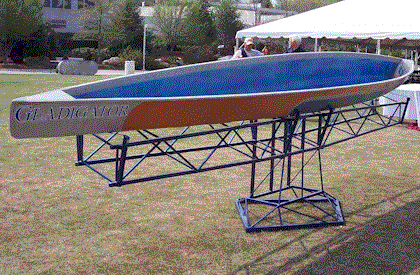
Over the last 5 years, Florida’s design
teams have developed increasingly swift and maneuverable hulls. This year,
the Gators refined their reverse rake stern to
further optimize hydrodynamic performance, and integrated components of previous
designs to fit new parameters. One of the outstanding features of "Gladigator"
is its radical asymmetry.
This year the designers synthesized
the bow and stern rockers with a soft chine design to
allow their teams to obtain the optimum balance of speed, stability, and
agility. The
soft chines in the bow reduce the section area
and help to minimize the wetted surface area in this region... where flow is
more laminar and, as
a result, frictional resistance is high.
Last year's team observed unexpected
sluggishness off the starting line due to the
truncated reversed rake stern. To combat this, Florida's new boat will be
designed with a reversed rake stern that comes to an edge rather than an oblique
plane. This more closely resembles modern crew shells rather than America’s
Cup yachts. This refinement will allow "Gladigator's"
hull to maintain superior hydraulic performance while still allowing it to
function efficiently at a variety of water levels as would
a traditional canoe hull.
The team conducted small-scale tests
of various bow and stern modifications
to validate their new design. A basswood
model was constructed at 1/6th
scale with interchangeable resin bows and sterns. Each
desired bow and stern combination was placed in a
hydraulic flume and pulled through the water by a falling weight. Six to
ten trials were conducted for each combination with
three different weights. At constant velocity, hydraulic
drag force on the model is equal to the weight of the falling mass. Therefore,
all tests run with a given falling mass are subject to
identical hydraulic forces, so that the fastest model exhibits
the highest efficiency. | 


