Research and Development
 The following paragraphs describe a brief history of my involvement in
research at
UAH and the efforts of some of the students that worked with me on thesis and/or dissertation research. I have several other
topics that I would like to pursue and am open to your suggestions for working
together on a project of mutual interest. I hope to hear from you
soon. Thanks!
The following paragraphs describe a brief history of my involvement in
research at
UAH and the efforts of some of the students that worked with me on thesis and/or dissertation research. I have several other
topics that I would like to pursue and am open to your suggestions for working
together on a project of mutual interest. I hope to hear from you
soon. Thanks!
John A. Gilbert - john.gilbert@uah.edu
History: Although the University of Alabama in Huntsville
had been involved in optics education for many years before I came here, the
founding of its Center for Applied Optics (CAO) in May 1985 marked the beginning
of a major increase in optics emphasis. Shortly after I arrived, I
established an optics laboratory in the engineering building. This 2,000
square foot facility included four separate laboratories and one darkroom.
I used the laboratory to develop new, non-destructive, non-contact, laser-based
testing methods in the areas of experimental mechanics and applied optics.
A portion of the complex (one of the four labs) was designed to teach optical
techniques for stress analysis.
In 1986, our UAH president and the CAO director approached me
with their plans for expanding the optics initiative and asked me to make a
pitch to Congressman Bevill along these lines. During a presentation made
mostly by my students, we pointed out why our existing facilities were somewhat
inadequate (vibration problems, water surges, power surges, etc.) and laid out
global plans for a proposed expansion.
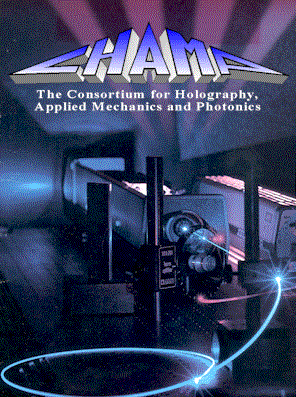
The proposal for our optics building was submitted to Washington
in January
1987. The photo shown below was taken in my laboratories and appeared on the front cover.
After generating $14 million dollars, we began construction in 1990-91.

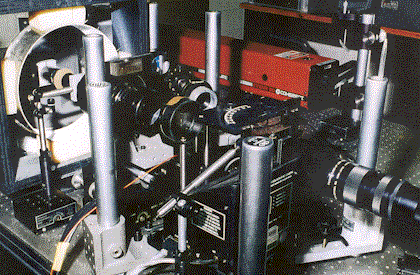
Since then, the facilities that I built and maintain there have
allowed my students and me to introduce new concepts in optical metrology
ranging from holographic/fiber optic recording, real-time moire interferometry,
ultra-low frequency holography, shadow speckle metrology, and radial metrology,
to photoelastic fiber-optic sensing, and diffractive optic interferometry.
In 1999, I introduced the STARS concept (strategically tuned absolutely resilient
structures) and established additional laboratories in the West Wing of Tech
Hall for research in composite materials. It gives me great
pleasure to tell you a little about some of these efforts.
David Alldredge was an MAE student employed by Boeing. He
worked with Dr. Cole of MSFC/NASA, Dr. Ashley of MICOM, and me to refine our
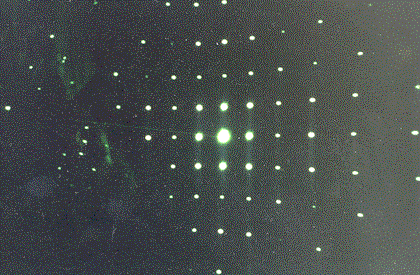
collaborative work in the area of diffractive optic interferometry. The
technique was recently developed by one of my graduate students and me. It
is the only technique that I know of that can be used to measure three
components of displacement, simultaneously. Remarkably, we have shown that
this can be done with variable sensitivity over twice the range of the most
sensitive methods currently used to measure in-plane and out-of-plane
displacement: moiré interferometry and holographic interferometry. I
expect David’s efforts to revolutionize the way that measurements are made in
optical metrology.
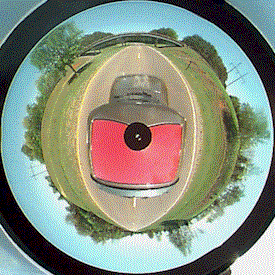
Timothy Barnett was a CEE student working with me to develop a
panoramic detection system for collision avoidance and traffic control. He
was employed by the City of Huntsville as their senior traffic engineer, is the
past-president of our local ASCE Branch, and a professional contact member for
our ASCE student chapter.
Paul Bookout was an MAE student employed by NASA. He worked with me in the area of structural analysis.
Paul did a statistically generated weighted curve fit of residual functions for
modal analysis of structures. The tools that he developed aided in design and analysis of products.

Jeffrey Lindner was a CEE student who worked with me in the area of modal analysis.
We developed some of the most powerful optical diagnostic tools in the
world and have published and presented our work on numerous occasions.
Experiments that we conducted on components designed for the SSME have been
featured on the cover of Experimental Techniques. We were invited to
present our findings at a recent International Congress on Experimental
Mechanics and our efforts were very well received.
Heru Santoso was a physics student that developed a panoramic
projection system under my direction. The other members of his thesis
committee, consisting of fellow colleagues from the college of science, were
favorably impressed by his thesis presentation and Heru received and accepted a very lucrative job offer from
Corning..
Robert Vaughan was an aerospace engineer who worked with me in the area of advanced composite
materials while on dissertation leave from MSFC/NASA. His efforts are
stellar and complement other ongoing efforts to develop embedded information
systems; and, strategically tuned, absolutely resilient structures
(STARS). His work laid the groundwork
for the further development of STARS, and this has resulted in some of the
most significant contributions of my academic career.

Ehan Weech was a CEE student who successfully developed a stereoscopic
imaging system that can be used to locate and contour objects surrounding
it. He conducted an uncertainty analysis and refined a
calibration procedure with structured targets in an effort to successfully
complete his work.
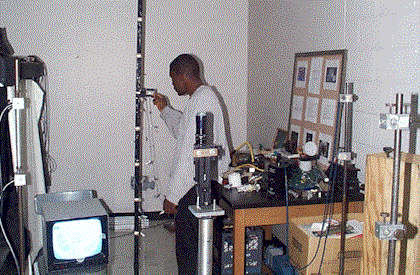
I am also working with a number of other undergraduate and graduate students
on a variety of projects related to everything from independent study to student
chapter activities.
The information on this page is being continuously upgraded, so this page is:

